Fractional AI Consultant / Builder / 2026
Paul Chambers

Paul Chambers

Fractional AI & Automation Consultant

I help companies in the $1M-$10M range stop buying AI tools and start building AI systems that actually work. Most businesses at this stage have outgrown their informal processes but aren't ready for enterprise solutions. I come in as a fractional operator, build the automation and AI infrastructure their team needs, then teach the team to run it without me. Two layers: systems built, teams equipped.

12
Shipped Products
107
Claude Skills
6
AI Agents
23+
MCP Servers
02 · About

Profile

Background, skills, and how I work.

Location
Marina del Rey, California
Remote · United States
Experience
Senior
Full Time or Fractional
Company
Fractional AI & Automation Consultancy
Engagement
Retainer or Project
3-month minimum for retainers
Systems Skills
AI Implementation Workflow Automation n8n System Architecture API Integration MCP Servers
Enablement Skills
AI Strategy Prompt Engineering Context Engineering Specification Precision Claude Code LLM Orchestration
03 · Shipped Work

What I build

Products and systems I've designed, built, and deployed. Each one solves a real problem for a real user or team.

The Contractor's Wife thecontractorswife.app
Production
The Contractor's Wife home page

Voice-first PWA where a contractor talks into their phone and AI routes everything to the right place: materials to shopping lists grouped by store, dates to Google Calendar color-coded by job, tasks, or per-job notes.

Fuzzy entity resolution matches phrases like "the Kellogg job" or "Chris's place" to the correct project by injecting the active job list into the system prompt. A Claude Vision path turns site photos plus voice into structured scope with materials, code flags, and cost estimates. Meeting recorder runs Deepgram diarized transcription into summarized notes. Voice input queues offline for dead zones.

Crew management with row-level security so employees see only assigned jobs. Subcontractor directory with per-job placement.

Stack
Next.js, React, TypeScript, Supabase (Postgres + RLS), Anthropic SDK, Deepgram, Google Calendar API, Zustand, Tailwind. Deployed on Vercel.
Currently in use by its target end user running real remodel jobs daily.
Visit App ↗
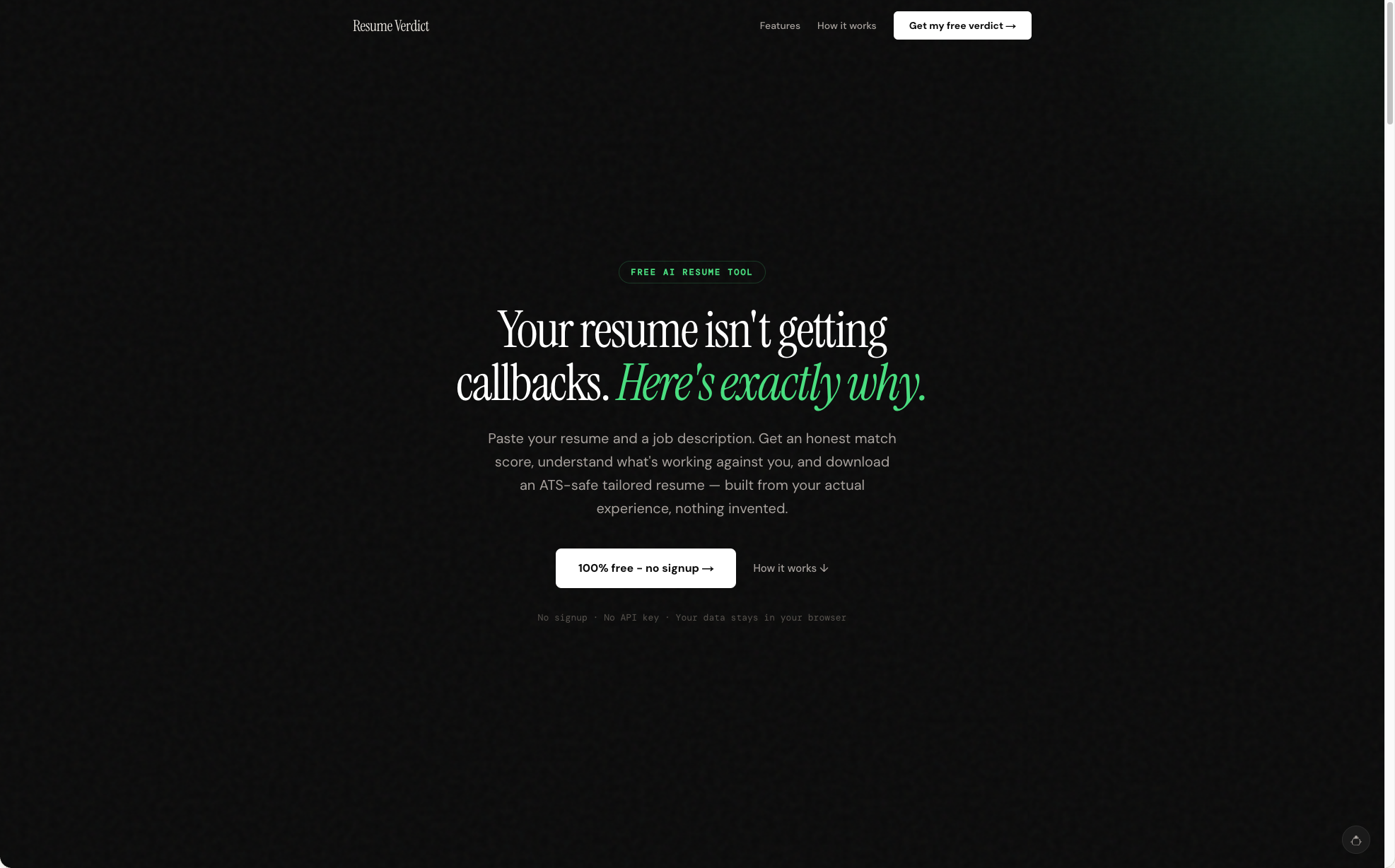
Resume Verdict resumeverdict.app
Live
Resume Verdict home page

Free AI resume diagnostic. Paste a resume and job description, get a match score (0 to 100) across four dimensions (keyword match, experience relevance, trajectory fit, ATS parsing), a GO / FIX FIRST / PASS verdict, and a downloadable ATS-safe Word doc rewritten to mirror the job listing.

The core constraint: no fabrication. A three-layer guard enforces it. System prompts restrict the model to user-provided evidence. A five-question intake surfaces real stories before tailoring runs. A separate fact-check pass verifies every rewritten bullet against the original resume, regenerating failures with per-claim feedback.

Company-targeting mode: paste a URL instead of a job description and get a tailored resume with positioning angle. Cost-tiered model use (Haiku for diagnosis, Sonnet for generation). Word-level diff shows what changed.

Stack
Next.js, React, TypeScript, Tailwind, Anthropic SDK, Upstash rate limiting, client-side DOCX export. No database. Live on Vercel.
Visit App ↗
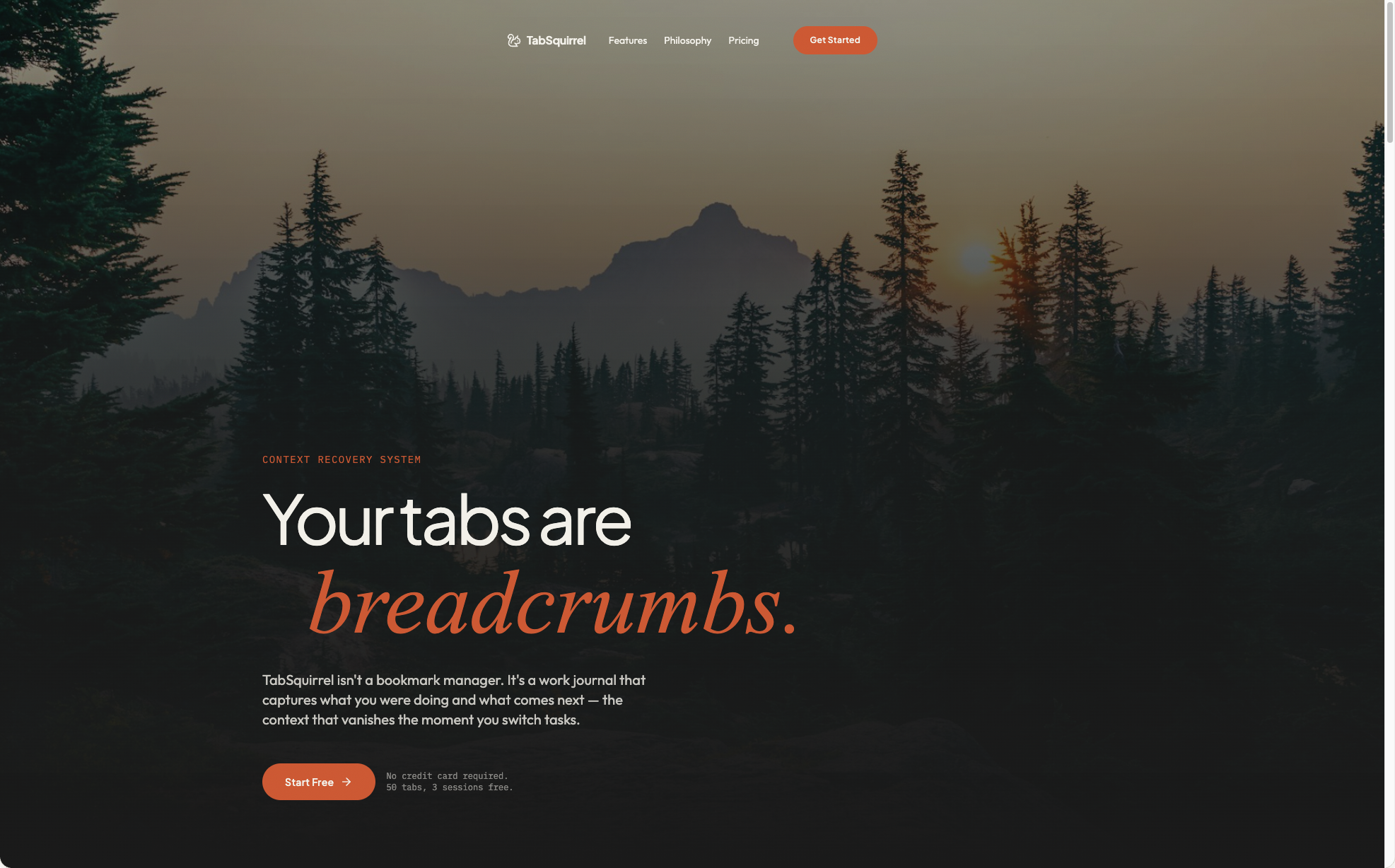
TabSquirrel tabsquirrel.com
Store Pending
TabSquirrel home page

Chrome extension that captures open tabs, auto-categorizes them, and lets users annotate, snooze, and snapshot them into restorable sessions. Built for knowledge workers who keep dozens of tabs open as external memory and lose time re-orienting after each context switch. Where competitors save URLs, TabSquirrel saves context: what the user was doing and what comes next.

The build pairs a Manifest V3 extension with a React SPA over a postMessage bridge and externally_connectable, avoiding a hardcoded extension ID. Free-tier limits are enforced at the database layer through a Postgres BEFORE INSERT trigger using SECURITY DEFINER. A split tabs/tab_meta model with URL normalization handles dedup on import. Every table runs row-level security keyed to auth.uid().

Stack
React 19, TypeScript, Vite, Tailwind, Supabase (Postgres, magic-link auth, Deno edge functions), Stripe, Vercel. Feature-complete and deployed.
Visit Site ↗
CallProof
Client Deploy
CallProof home page

Automated pipeline that ingests sales call transcripts, extracts structured coaching insights, grades each call A through F, and verifies every product claim against a 672-document knowledge base embedded in Supabase pgvector.

Built for the sales director at Tracker Products. Two AI stages: Gemini 2.0 Flash returns strict JSON (agency, persona, objections, competitor mentions, rubric score); a LangChain compliance agent checks each claim against the knowledge base, returning PASS, FLAG, or REVIEW with evidence quotes.

Reps contest results via tracking codes in Slack, where a router resolves disputes. Reliability includes scheduled batch runs, two-layer deduplication, malformed-JSON repair, and two-step archiving.

Stack
n8n orchestration, Gemini 2.0 Flash, LangChain, Supabase Postgres with pgvector, OpenAI embeddings, Airtable, Google Drive, Gmail, Slack. Running in production.

Tracker Nexus Knowledge Base
Client Deploy
RAG Knowledge Base

Internal AI knowledge base for Tracker Products. The system turns SOPs, product documentation, and institutional knowledge into a searchable operating layer for the team.

Three modules: War Room for RAG chat, Knowledge Factory for document ingestion, and Ops Manual for SOP browsing. It was built for a real company with real team usage, not as a demo.

The key architecture decision was consolidating auth, row-level security, storage, and vector search inside Supabase instead of splitting the system across separate tools.

Stack
Next.js, React, Supabase Postgres with pgvector, Supabase Auth, RLS, Storage, OpenAI embeddings, GPT-4o-mini classification, Tailwind, Netlify.
Production client system from a 14-month fractional engagement.
Open Brain github.com/fullREFIT/open-brain
Live
AI Memory Layer

Persistent memory system for AI work. Open Brain captures decisions, observations, people notes, references, and tasks from AI sessions so future agents can search and reuse context instead of starting over.

The system separates tasks from thoughts, deduplicates pending work by semantic similarity, supports typed relationships between thoughts, and exposes read and write tools through an MCP server.

This is the infrastructure I use daily to keep AI work connected across sessions, tools, and projects.

Stack
Supabase Postgres with pgvector, Edge Functions, Deno, TypeScript, OpenRouter embeddings, Slack capture, MCP protocol, relationship graph tools, task workflow.
View Repo ↗
AI Architects Roundtable Recap System ai-architects-roundtable-call-recap.vercel.app
Live
Recap Automation

Publishing system for a weekly AI practitioner roundtable. It turns call transcripts and edited recaps into a static web archive that updates through the repo and deploys on Vercel.

The workflow pairs transcript files with recap markdown by date, rebuilds the public archive, and keeps the publishing path repeatable without hand-editing pages.

It is a practical example of content operations as infrastructure: capture the source, turn it into a useful artifact, publish it, and keep the process maintainable.

Stack
Zoom transcripts, markdown recaps, Python static build script, GitHub, Vercel, n8n automation, date-based publishing workflow.
Visit Archive ↗
1Password Environment System
Internal Tool
Credential Ops

Credential management workflow that bridges 1Password secrets into project-specific development environments without copying keys into code, chats, or local notes.

The system uses reusable environment templates, shell helpers, biometric 1Password CLI authentication, and project setup patterns so AI-heavy development work can access the right credentials safely.

It is not a flashy app. It is the operating layer that keeps multi-project AI work from becoming a security mess.

Stack
1Password CLI, shell scripts, zsh helpers, env templates, Touch ID auth, project-specific credential patterns, local developer tooling.
Used across AI, automation, and web app projects.
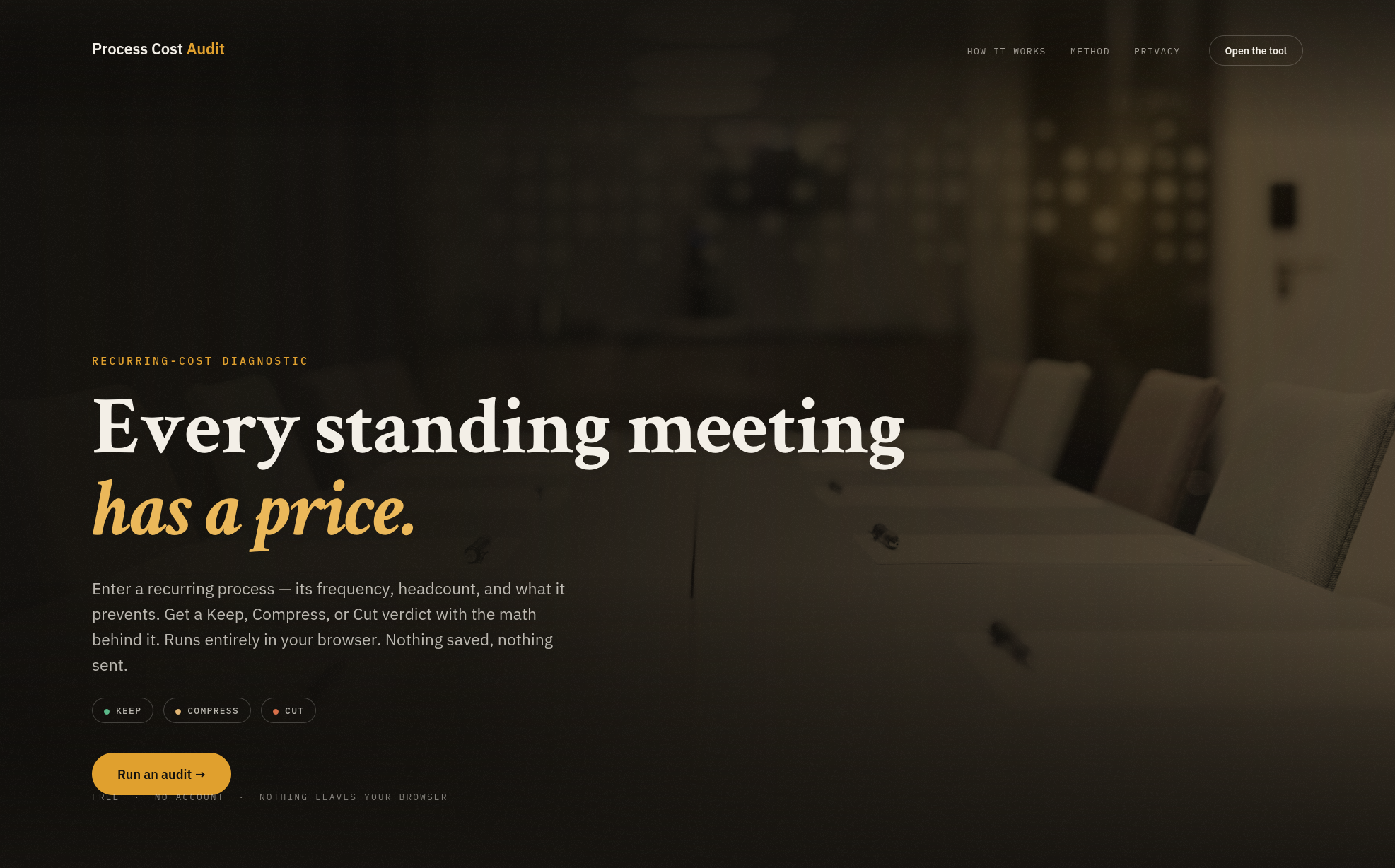
Process Cost Audit
Free Tool
Process Cost Audit home page

Interactive tool that audits recurring business processes for hidden cost. Enter a process with its frequency, headcount, duration, and what mistakes it prevents. The app returns a Keep, Compress, or Cut verdict with rationale and a specific recommended action.

Runs as a deterministic rules engine with no AI calls and no network requests. A cost model converts inputs to monthly team-hours using per-frequency multipliers, and a 40-hour threshold separates Compress from Keep. Rationale and actions generate from live numbers rather than canned text. Processes accumulate into a ranked summary table with clipboard export. Everything runs client-side, nothing saved or transmitted.

Built for operators and team leads who accumulate standing meetings, reviews, and reports that nobody re-evaluates because the cost sits in payroll hours and stays invisible.

Stack
React with hooks, zero external dependencies. Free to use.
04 · How I Work With AI

Operating model

How AI fits into how I build, deliver, and run a business.

Q1

How has AI multiplied your output?

I built a sales call analysis system for a client where the sales director reviewed maybe 5 calls a week out of 40+. The automation now processes every call: transcribes via Deepgram, runs analysis through Gemini, cross-references product claims against 672 documents in a vector database, and delivers graded reports same-day. Coverage went from partial to complete overnight.

On my own business: 100+ Claude skills chain together so a single command runs topic origination, dedup against existing content, script generation, slide production, and lead magnet specs. A full day of content production per video is now about two hours, mostly review and recording.

Q2

Describe a task where you wrote a spec for an AI agent and it executed autonomously.

I had a 52-task backlog spanning content production, workflow automation, data pulls, and infrastructure fixes. I wrote a universal batch execution wrapper for Cowork (Claude's autonomous surface) that triages every task silently, loads context conditionally, runs preflight checks, then executes in parallel. The spec: never ask questions mid-run, route blockers to a REQUIRES_PAUL block, skip over fabricate, end with a six-section status report.

The agent classified each task as SKIP, EXECUTE, or PARTIAL, handled what it could, and produced a clean report of completions, skips, and blockers. I reuse the same wrapper by appending a new task list.

Q3

What's your delegation radius?

I delegate to AI: first drafts of all written content, code generation, research synthesis, workflow building, data extraction, scheduling, and repetitive file operations. I have six named agents handling different surfaces (Slack relay, outreach automation, YouTube production, general execution).

I review: anything buyer-facing before it publishes. Voice and tone are where AI drifts fastest, so every LinkedIn post, email, and script gets a human pass against documented quality gates.

I won't delegate: strategic decisions about positioning, pricing, or which clients to pursue. Client conversations. Anything requiring judgment about relationships or trust. The "should we" questions stay with me. The "how do we" questions go to AI.

Q4

What will you delegate to AI in 12 months that you can't today?

Full-cycle lead research through qualification. Right now I use AI for individual steps (Apollo pulls, enrichment, ICA scoring) but a human stitches the pipeline together. In 12 months I expect to hand an agent a target profile and get back qualified leads with personalized outreach drafted and staged.

Multi-agent content production where I approve a topic and the system produces script, slides, lead magnet, distribution copy, and thumbnail with one review pass instead of five sessions.

Real-time client system monitoring where agents flag anomalies in deployed automations before the client notices. The pieces exist. The orchestration layer that ties them into a reliable autonomous loop is what's still being built.